Design Leadership  ·  Product Strategy  ·  AI-Powered Experience

I turn design into
organizational advantage.

12+ years leading design for companies like Delta, the NBA, and Kroger. I've spent most of that time convincing people that design belongs in the room before the decisions get made, not after. Turns out it's a pretty good argument.

Trusted by

Kroger Delta Air Lines NBA The Home Depot Coca-Cola Cox Automotive Truist Bank AT&T
Approach

Design is a strategic
business function.

Most organizations treat design as production. Work comes in, gets executed, ships. Repeat. I've spent my career making the case that this is exactly backwards. Most of the time, I can prove it.

The problems worth having are the ones where design and engineering are still arguing about something that hasn't been built yet. That's usually where the real decisions get made. I've been in that argument inside grocery ecommerce, airline ops, sports media, and enterprise analytics. Different industries. Same basic fight.

Leadership & Culture

I've hired designers, mentored them through career pivots, and helped scale design practice inside organizations that were figuring out what that even meant. The hard part isn't finding good people. It's demonstrating what good looks like in practice, and helping the team hold onto that consistency even when things get busy.

AI & Data-Driven Products

ML introduces a design problem most teams underestimate: the system is making decisions the user can't see. A big part of solving that is understanding and documenting the journey data takes before it surfaces as a recommendation or an output. Making that legible to users, without turning it into a lecture, is harder than it sounds. I've worked through it on recommendation engines, conversational AI, and ML Ops tooling. Turns out I like this kind of problem.

Product Strategy

I run discovery, sit in roadmap sessions, and push back when I think the prioritization is off. What I bring to those rooms isn't polish. It's a point of view on which problems are worth solving, and enough fluency in business to make that argument without losing the room.

Selected Work

Strategy in action.

Retail & eCommerce  ·  AI & Personalization Design Leadership

Kroger Personalization & Discovery

Challenge

Kroger's personalization and discovery systems touch nearly everything a customer finds and buys online. When I joined, design had almost no influence over how those systems got built. Data science owned the roadmap. Engineering owned the execution. Design got called in at the end to make things look reasonable — which meant the hardest problems had already been decided without us.

Approach

I stopped waiting to be invited and started showing up earlier. That meant getting into the rooms where ML models were being scoped — not to approve them, but to ask the user questions nobody else was asking. What happens when the recommendation is wrong? What does the customer see, and what do they do next? Rapid prototyping became our way of pressure-testing algorithmic decisions before engineering spent weeks building something that confused people. We used LUMA facilitation methods to run discovery sessions that got design, product, and data science speaking the same language.

Outcome

We shipped Kroger's first conversational AI shopping tool. The ML Ops platform work cut recommendation deployment cycles from weeks to hours. The 'Yearly Checkout' feature, a personalized annual summary, drove real gains in retention. The harder work was helping engineers and data scientists understand what design actually contributes before the decisions get made. That one doesn't show up in a release note.
Service Blueprint
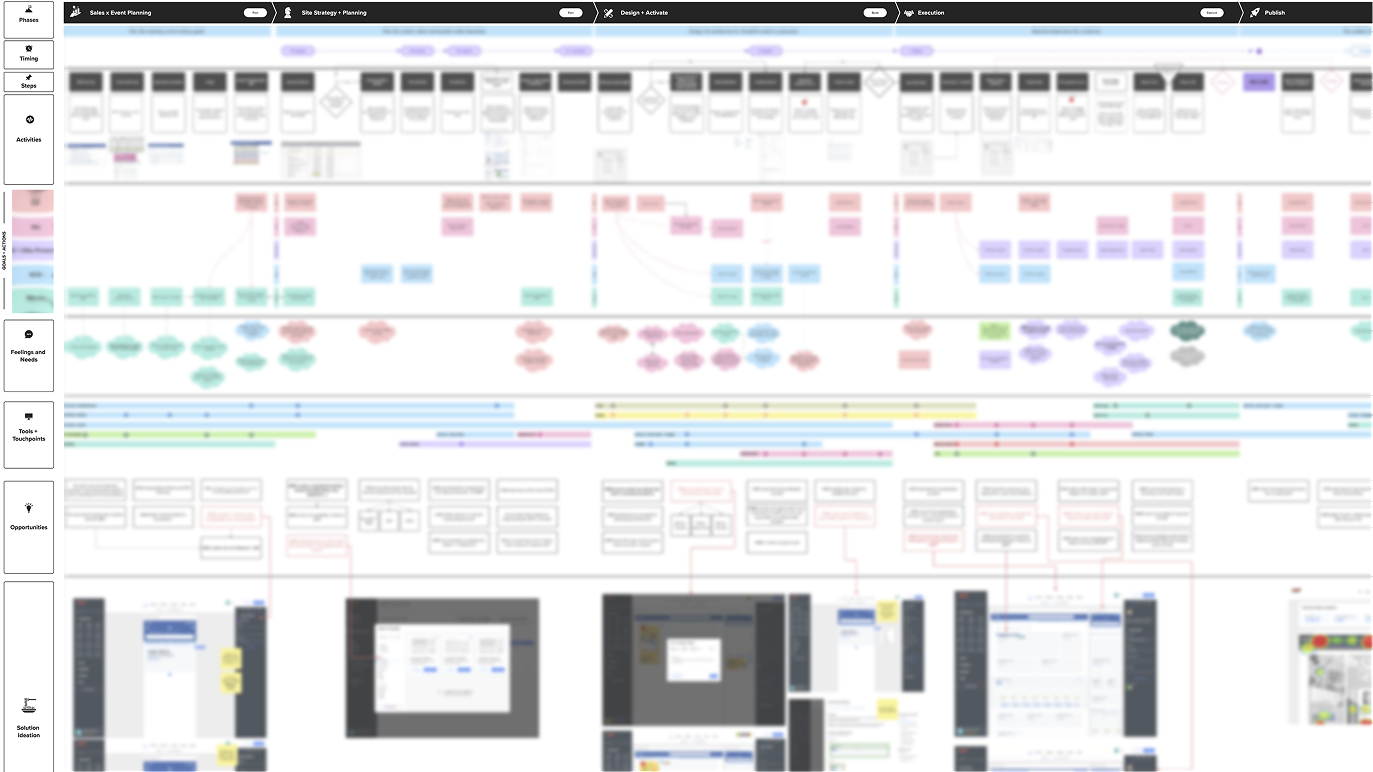
Kroger service blueprint — cross-functional journey map spanning sales, site strategy, design, execution, and publish phases across DX, product, merchandising, and KCS teams
Service blueprint · Cross-functional discovery across sales, strategy, design & execution
Role Design Lead, Personalization & Discovery
Scale Enterprise ecommerce · Millions of customers
Outcome Conversational AI UX shipped; deployment cycles weeks → hours
Aviation  ·  Enterprise Operations UX Strategy

Delta Air Lines — Crew Management & Command Center

Challenge

Delta's internal tools, crew scheduling, turbulence tracking, command center operations, had been built by different teams at different times. Nobody designed them to work together because nobody was ever asked to. When we talked to ops staff, one phrase kept coming up: situational awareness. The ability to know exactly what's happening, right now, across all the moving parts. Context-switching between disconnected systems with their own logic and terminology was chipping away at that. Under normal conditions, that's friction. Under irregular operations, it's a serious problem.

Approach

The client came in asking for a UI refresh. Before committing to a direction, we spent time with operations staff watching how they actually worked: what they checked first, where they got stuck, what they'd learned to work around. That shifted the conversation. A fresh coat of paint on four disconnected systems wasn't going to restore situational awareness. Working together with the client, we reframed it: what the team actually needed was a shared design language that let someone move between tools without losing their footing.

Outcome

The design language we built got adopted org-wide — not as a style guide people reference once and forget, but as the actual standard new tools were built to. Getting teams who own their own products to share a common foundation takes more convincing than any deliverable. We got there. Took a while.

Process Journeys and App Ecosystem
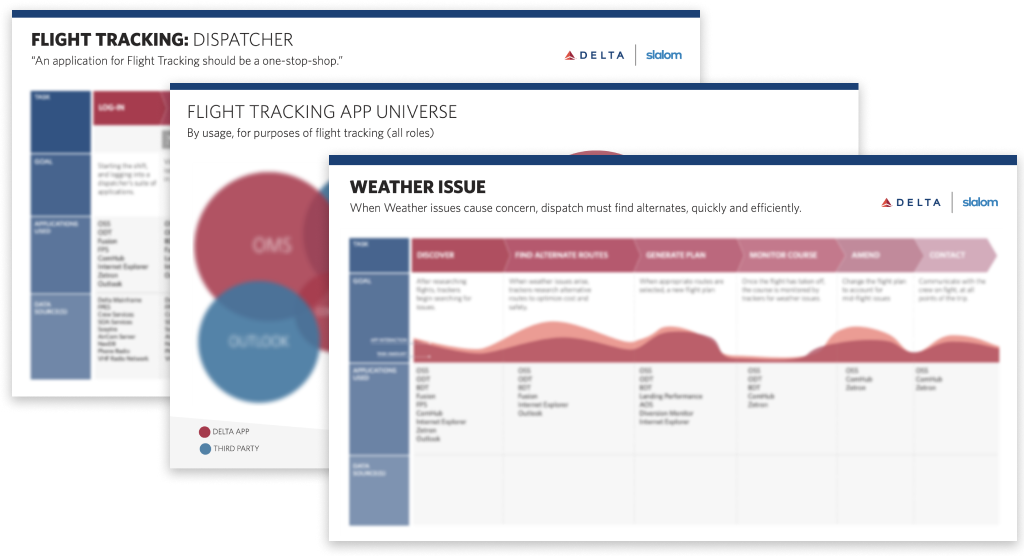
Delta flight tracking journey maps — task flows and goals mapped across Dispatcher, Sector Manager, and Strategic Planning Team personas
Flight tracking journey maps · Dispatcher, Sector Manager & Strategic Planning Team personas
Role Design Strategy Lead (Slalom Consulting)
Scale Enterprise / Global Operations
Outcome Shared design language adopted org-wide
Sports & Media  ·  Multi-Platform Platform Strategy

NBA Digital — Cross-Platform UX Strategy

Challenge

Connected TV and OTT streaming were still relatively new territory for sports media. The NBA had web and mobile figured out, but integrating streaming platforms into a coherent fan experience was a different problem. Each surface had its own content model, its own interaction patterns, its own assumptions about what a fan needed in that moment. The question wasn't just how to make things look consistent. It was how to build something intentional across all of it, starting with the newest and least understood piece: OTT.

Approach

We built a framework, not a design system, but a decision-making tool. It mapped how fan context changes across surfaces and how those surfaces talk to each other. In a multi-screen experience, the TV isn't just a big phone. The phone isn't just a small TV. Someone watching a game on their couch with a phone in their hand is doing two things at once, and the experience should account for that relationship, not just each screen in isolation. The framework gave teams a way to make those decisions intentionally. We ran working sessions with stakeholders across digital, broadcast, and arena operations to test it against real scenarios before it went anywhere near a product.

Outcome

The framework got adopted across NBA digital. But the more useful thing it changed was what the internal conversations were even about. Less "why doesn't mobile match web" and more "what does someone actually need in this moment, on this screen." That's a better conversation to be having, and it was a new one for them.

Delivered Work
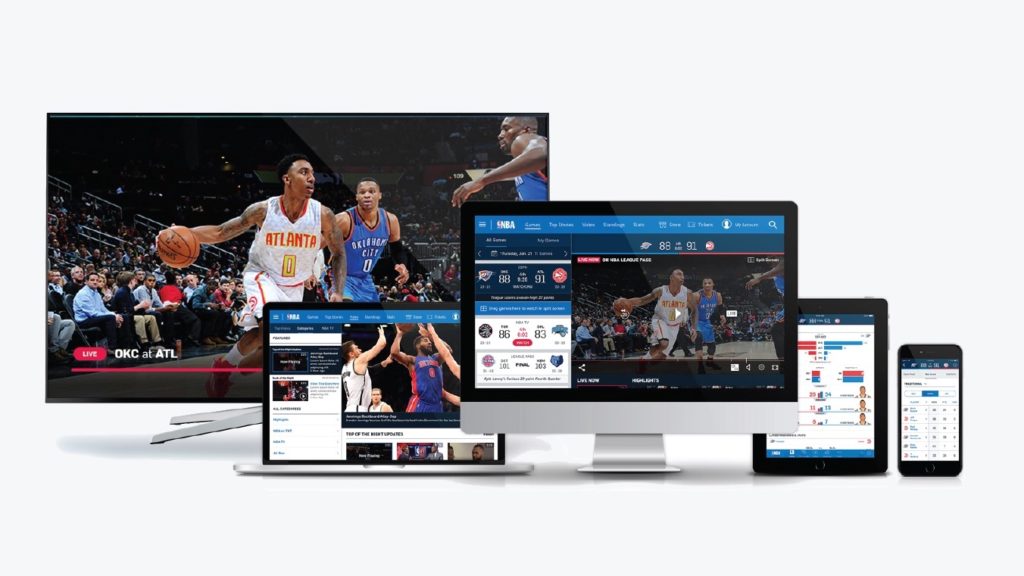
NBA digital experience across TV, laptop, desktop, tablet, and mobile — consistent cross-platform UX strategy
NBA digital experience · TV, web, tablet & mobile — one consistent connected experience
Role UX Strategy & Systems (Slalom Consulting)
Scale Web, mobile, OTT · Global audience
Outcome Connected experience framework adopted org-wide
Analytics  ·  Enterprise SaaS Experience Design Lead

84.51° — Analytics Products for Enterprise Clients

Challenge

84.51° is Kroger's data science and insights arm, smart people building analytics products for large enterprise clients. Each product team had their own designers, their own component libraries, their own way of solving the same problems. That works fine until a client uses two products and wonders why they feel like they came from different companies. It also slows everyone down, because every team is solving problems the org has already solved elsewhere.

Approach

Before pushing for a design system, which is the obvious answer and sometimes the wrong one, we mapped where the actual pain was. Where were users confused? Where were designers rebuilding the same thing twice? That gave us somewhere specific to start. We built around those gaps and kept the teams involved so the whole thing didn't show up one day as a mandate nobody asked for.

Outcome

Teams adopted it and kept shipping, which is honestly the only metric that matters for a design system. If it slows people down, it gets ignored. This one didn't. Client feedback on consistency improved, and designers stopped spending half their time rebuilding things that already existed somewhere else in the org.

Role UX Lead, Experience Design
Scale Multiple product teams · Enterprise B2B clients
Outcome Design system adopted; design maturity elevated org-wide
Speaking & Facilitation

On the record.

I've keynoted conferences, run workshops, and organized events — sometimes all three at the same one. The topic changes depending on who's in the room, but it usually ends up being some version of: here's what design actually looks like when it's working, and here's why it so often doesn't.

Keynote Speaker

DMI Design Leadership Conference

How design stops being a service and starts being a function that actually shapes decisions — and what it takes to make that argument in rooms where design isn't the default answer.

World IA Day Cincinnati

Annual keynote on where information architecture is heading — how AI changes what structure even means when the interface is increasingly invisible. Also serves on the Global Board of Directors.

Conference Speaker

O'Reilly Design Conference

What it actually takes to design across TV, mobile, web, and everything in between — not just visually consistent, but contextually right for where someone is and what they're trying to do.

Digital Summit — Atlanta, Charleston, Dallas

Designing for 10 feet and beyond: screens, spaces, and the connected experience across the modern home and enterprise.

Internet Summit

Why most digital transformation efforts underinvest in design until something ships that doesn't work — and what earlier involvement actually looks like in practice.

Workshop Facilitator

Agile Alliance

Working sessions focused on getting design and engineering to stop talking past each other — using LUMA methods to build a shared language before the sprint starts, not after something ships wrong.

IXDA Conferences

Sessions on design systems, research methods, and how to scale design practice without losing the things that made it work when the team was small.

Enterprise Teams (Internal)

LUMA-certified. Runs discovery workshops and cross-functional alignment sessions inside large organizations — the kind where the problem isn't a lack of ideas, it's that nobody can agree on which one to actually pursue.

Available for

  • Keynotes on design leadership & organizational maturity
  • Conference talks on AI-powered product design & connected experience
  • Workshops on human-centered design methods & discovery practice
  • Internal facilitation for product, design, and cross-functional teams
  • Panel discussions on the intersection of design strategy and business outcomes
Inquire About Speaking or Facilitation
LUMA Certified Human-Centered Design — Instructor, Facilitator & Practitioner
Global Board of Directors World IA Day, Inc.
Education B.S. Design Science, Visual Communication — The Ohio State University
12+ Years Leading design strategy for Fortune 500 organizations
About

Based in Cincinnati.
Thinking at scale.

I started as a designer who spent way too long on kerning. Good times. Somewhere along the way I realized the work I cared most about happened before the decisions got made, not after. So I started showing up earlier. That's more or less how I ended up leading design for a global airline, the NBA, and one of the largest grocery retailers in the country.

Cincinnati native, Ohio State grad, and board member for World IA Day. I speak at conferences when I have something worth saying, run workshops when teams need a push, and spend probably too much time thinking about the gap between how design gets talked about and how it actually works inside real organizations. Spoiler: it's messier, more political, and more interesting than the articles make it sound.

Contact

Let's talk.

Consulting, speaking, facilitation, or just a conversation about why design keeps ending up at the wrong end of the process — I'm up for any of it. Drop me a line.

Cincinnati, OH  ·  Helping teams on site and remote.